

EUDR for wooden pallets, crates and timber packaging: due diligence statements, reference numbers, deadlines
The EU Deforestation Regulation (EUDR) applies from 30 December 2026 – and for timber businesses there is no extra time for small companies. What pallet manufacturers, crate builders, sawmills and timber traders need to know now: who files a due diligence statement, which data it requires, how reference numbers travel through warehouse and production, and which exemptions apply to packaging.
Key points at a glance
- Deadline 30 December 2026 – small timber businesses included. The postponement to June 2027 for micro and small companies expressly does not apply to timber products already covered by the old EU Timber Regulation (EUTR) – so not to sawn timber and pallets either.
- Only whoever first places the wood on the market files a due diligence statement. Anyone making pallets or crates from it is a "downstream operator" and records suppliers and customers.
- New pallets and crates sold as products are covered. Accompanying packaging, reusable load carriers in use and used pallets are excluded.
- Wood from Germany and the EU counts as "low risk". That simplifies the risk assessment, but the operator still needs the geolocation of the harvest plots.
Which timber products the EUDR covers
Wood is one of seven relevant commodities under the Deforestation Regulation. Annex I lists the covered products by customs code – from roundwood (4403) and sawn timber (4407) to wooden packaging under 4415: packing cases, crates, drums, cable drums, flat pallets, box pallets and pallet collars.
Since Delegated Regulation (EU) 2026/2102 (in force since 18 September 2026), entry 4415 expressly excludes:
- used and second-hand products,
- single-use packaging used exclusively to support, protect or carry another product and presented with it,
- packaging clearly suitable for reuse from its first use for that purpose.
Also excluded is waste wood whose life cycle has ended and which would otherwise be waste. By-products from ongoing production, such as sawdust, are not covered by this exemption.
According to the Commission's FAQ, what decides whether packaging "accompanies" the goods is whether it is classified for customs together with them – not whether it is invoiced separately.
Roles in the timber chain: who has to do what?
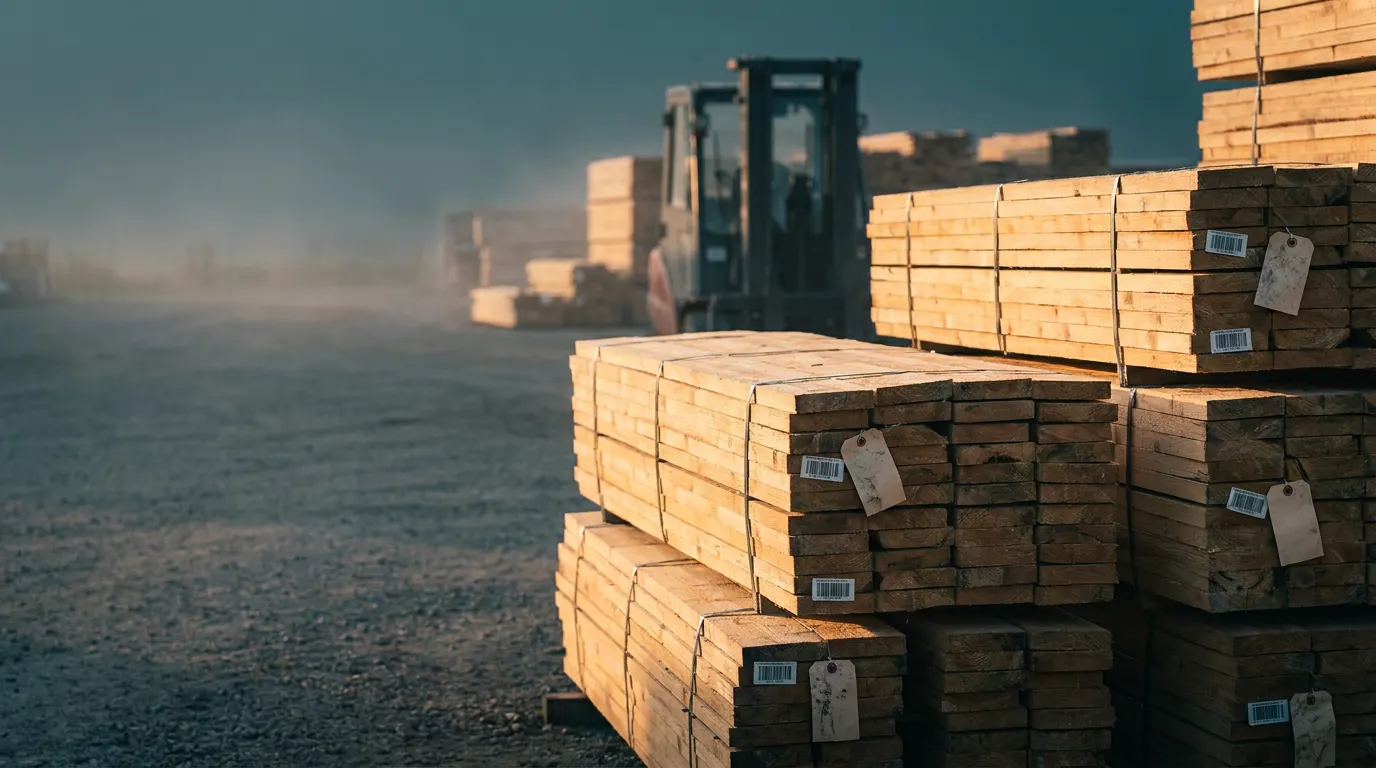
Since the reform by Regulation (EU) 2025/2650, the principle is effectively "first placer only": the due diligence statement is filed by the operator who first places the wood on the EU market or exports it. All later stages only pass on information. The former special rule for SMEs has been deleted – it is replaced by the new role of downstream operator, regardless of company size.
Operator
First places wood on the EU market or exports it – e.g. a forestry business selling roundwood, an importer of sawn timber, a pallet importer.
- full due diligence (Art. 8–11)
- due diligence statement in the EU information system
- pass the reference number on to customers
Downstream operator
Makes new products from wood already covered by a statement – e.g. the pallet plant or crate builder using EU sawn timber.
- no due diligence statement of its own
- record suppliers and customers (name, address, e-mail), plus reference numbers where the supplier is an operator
- keep for 5 years; non-SMEs must also register and check before placing on the market
Trader
Makes timber products available without manufacturing them – e.g. timber or pallet trade.
- record suppliers and customers
- keep for 5 years
- report substantiated concerns
Micro and small primary operator
A small forestry business in a low-risk country placing wood it harvested itself on the market.
- one-off simplified declaration instead of one per delivery
- a postal address can replace geolocation
- not needed if the data is already in a national database
The due diligence statement step by step
For operators – for example when importing sawn timber or finished pallets – due diligence follows six steps:
- 1. Collect information (Art. 9): description with trade name, common and scientific name of the tree species, quantity, country of production, geolocation of all harvest plots with harvest period, suppliers and customers, and evidence of legality and deforestation-free production.
- 2. Assess the risk (Art. 10): including country risk, supply-chain complexity and the risk of mixing with wood of unknown origin. Document it and review it at least annually.
- 3. Mitigate the risk (Art. 11): additional information, independent audits; non-SMEs also need a compliance officer.
- 4. File the due diligence statement: in the EU information system (TRACES) with the Annex II data – including customs code, quantity, country of production and geolocation.
- 5. Pass on the reference number: the system issues a reference number; it goes to the customer and, on import, must be available to customs before release for free circulation.
- 6. Keep records: statements and documents for 5 years.
Geo-coordinates need at least six decimal places. Plots larger than 4 hectares require a polygon; below that, a single point is sufficient.
Wood from Germany: low risk, but no free pass
Implementing Regulation (EU) 2025/1093 classifies Germany and all other EU member states as low-risk countries. Only Belarus, North Korea, Myanmar and Russia are currently classified as "high risk".
For wood from low-risk countries, simplified due diligence (Art. 13) applies: risk assessment and mitigation are not required – but only if the risk of mixing with wood of other origin is negligible and this can be demonstrated on request. The information requirement, geolocation and the due diligence statement remain. If there are indications of risk, full due diligence applies again.
Imports from third countries: anyone importing sawn timber or pallets into the EU is an operator with full due diligence obligations – including a full risk assessment, depending on the country of origin.
Reference numbers through warehouse and production
In practice the EUDR rarely fails on the form – it fails on traceability within your own operation. Three points are decisive:
- Goods receipt: record supplier, reference number or supplier details and quantity for each delivery – directly on the batch.
- Warehouse and production: if lots are mixed, the plots of all lots involved must be declared for the result. The Commission does not accept mass balance with wood of unknown origin.
- Dispatch and invoice: the information goes to the customer – so your customer can meet their obligations too.
Special cases: repairs, pooled pallets, exports, old stock
- Repairs: for repaired pallets, only the newly added wood is covered by the EUDR – the repairer needs reference numbers for the new boards and blocks (Commission FAQ, EPAL).
- Pooled and reusable pallets: excluded from their first use as packaging; covered when first sold as new products.
- Exports: whoever exports products made from wood already covered by a statement is a downstream operator; no reference number is then needed at customs. Whoever exports wood for the first time needs a due diligence statement.
- Old stock: wood produced before 29 June 2023 and placed on the market from 30 December 2026 remains under the old EUTR until the end of 2029; from 31 December 2029 the EUDR rules apply to it as well.
Checks and penalties
Authorities check at least 1 % of operators each year for products from low-risk countries, 3 % for standard risk and 9 % for high risk. Penalties are severe: member states must provide for fines with a ceiling of at least 4 % of EU-wide annual turnover, plus confiscation of goods and revenues, exclusion from public procurement for up to 12 months and bans on placing products on the market.
In Germany, the implementing act was still a bill before the Bundestag at the date of this guide. It provides for state authorities for wood produced in Germany and the Federal Office for Agriculture and Food (BLE) for all other cases, along with fines and criminal provisions.
Implementing the EUDR in Business Central
At its core the EUDR is a data problem: origin, batch, quantity and the path of the goods must match without gaps – from goods receipt to invoice. That is exactly where duveka EUDR comes in, inside Microsoft Dynamics 365 Business Central. See it live in the free EUDR webinar; the packaging side is covered in our guide PPWR for wooden pallets and export packaging.
duveka EUDR
Reference numbers per batch, due diligence statements, Article 10 risk assessment, country risk and cockpit – right in the document.
duveka Timber
Industry solution for timber businesses – from log to invoice in one system.
duveka IPPC
ISPM 15 documentation on the same master data: species, origin, batch, treatment.
Overview PPWR & EUDR
Which regulation applies when? The decision matrix for wooden packaging.
Frequently asked questions on the EUDR for wooden packaging
Does the later June 2027 deadline apply to small pallet businesses?
No. The postponement to 30 June 2027 for micro and small companies does not apply to products already listed in the annex of the EU Timber Regulation (EUTR). These include sawn timber and wooden pallets – the EUDR applies to them from 30 December 2026, regardless of company size.
Does a pallet plant have to file its own due diligence statement?
Only if it places the wood on the EU market for the first time itself, for example by importing it. If it manufactures from sawn timber already covered by a statement, it is a downstream operator: it records suppliers and customers and its suppliers' reference numbers (where they are operators), and keeps everything for 5 years.
Do I need a due diligence statement for the pallets I ship my goods on?
No. Single-use packaging that exclusively supports, protects or carries your goods and is supplied with them has been expressly excluded since Delegated Regulation (EU) 2026/2102 – regardless of whether the goods themselves fall under the EUDR.
Wood from Germany is "low risk" – do I still need geolocation data?
Yes. Low risk only removes the risk assessment and mitigation (simplified due diligence under Art. 13). The information requirement, including geolocation of the harvest plots, and the operator's due diligence statement remain mandatory.
May I mix wood from different lots?
Yes, but then the harvest plots of all lots involved must be declared for the result. According to the Commission, mixing with wood of unknown origin makes the entire product non-compliant.
What applies to repaired pallets?
Only the newly added wood is covered, unless it is recycled wood. The repairer needs reference numbers or supplier details for the new boards and blocks.
What are the penalties for infringements?
The EUDR requires fines with a ceiling of at least 4 % of EU-wide annual turnover, plus confiscation of goods and revenues and exclusion from public procurement. The specific German rules are set out in the implementing act, which was still before the Bundestag at the date of this guide.